
The TaylorMade TP5 and TP5x are tour-level golf balls built for different swing types. Both feature a five-layer design and urethane cover for consistent speed, spin, and control. The TP5 offers a softer feel with higher spin, ideal for players who value precision and short-game control. The TP5x is firmer, faster, and lower spinning, giving stronger players more distance and a higher launch. Both benefit from TaylorMade’s new Speed Wrapped Core, enhancing feel without sacrificing speed. This guide explains how each model performs from driver to wedge, helping you choose the ball that best fits your swing and playing style.

Construction and Design Specifications
- Construction: Both use five-layer design with progressive stiffness from core to cover
- Cover material: Soft cast urethane on both models with enhanced durability
- Dimple pattern: 322 dimples with shallow depth and steep walls for improved aerodynamics
- Compression: TP5 at 88, TP5x at 93
- Color options: White, yellow, plus Pix, Stripe, and MySymbol variants
- Price: Both retail at $54.99 per dozen in the US and £44.99 in the UK
The Speed Wrapped Core represents a departure from traditional golf ball design. Engineers decoupled the relationship between sound, feel, and speed. This allows the balls to deliver a softer, more muted sound while maintaining fast ball speeds. The progressive five-layer design optimizes performance for different shots by engaging various combinations of the layers.
Driver Performance Differences
Driver performance shows clear differences between the TP5 and TP5x. Robot testing revealed that the TP5x produces higher ball speeds across all swing speeds tested. The gap widens at faster swing speeds, with the most notable difference appearing at 115 mph.
Spin rates favor the TP5x for reducing unwanted driver spin. The firmer model produces lower spin rates across all swing speeds tested. This spin reduction helps players maintain control and find fairways more consistently. However, lower spin does not automatically mean longer carry distances.
- Ball speed: TP5x registers faster speeds at 100, 107, and 115 mph swing speeds
- Spin rates: TP5x produces lower spin across all driver speeds tested
- Carry distance at 100 mph: TP5 and TP5x show similar results
- Carry distance at 115 mph: TP5x gains nearly 2 yards over TP5
- Launch angle: Both balls launch at similar angles
- Ball flight: TP5x produces higher peak height with flatter overall trajectory
The TP5x ranked as the third fastest ball at 100 and 115 mph across a 24-model robot test. It also spun less than all premium tour X-style competitors. Average swing speed players may struggle to unlock the TP5x’s distance potential off the tee, as the carry distance advantage only materializes at higher swing speeds.
Both models produce less driver spin than their previous generations while maintaining wedge spin. This improvement came from the new progressive five-layer design that optimizes spin characteristics for different clubs. The TP5 still generates more driver spin than the TP5x, making it better suited for players who already produce low spin rates naturally.
Iron and Approach Shot Performance
Seven-iron testing revealed closely matched performance between the two models. The most significant difference appeared in backspin rates, with the TP5 producing 204 more rpm than the TP5x. This extra spin translates to more stopping power on approach shots.
Both balls launched at identical angles with a 7-iron. Peak heights differed by just 0.2 yards, and descent angles varied by only 0.2 degrees. These minimal differences mean both balls perform similarly through the air with mid-irons.
- Backspin: TP5 generates 204 rpm more spin with 7-iron
- Ball speed: TP5x produces slightly faster speeds
- Carry distance: TP5x averages 1.3 yards longer
- Launch angle: Identical between both models
- Peak height: Within 0.2 yards of each other
- Descent angle: Within 0.2 degrees of each other
- Stopping power: TP5 ranked sixth highest spinning ball with 7-iron in 24-ball test
The TP5 outspun the Titleist Pro V1 with a 7-iron but remained 163 rpm short of the Pro V1x. Both TP5 models ranked above the test average for 7-iron spin rates. Players who prioritize mid-iron control should lean toward the TP5 for its added stopping power.
TaylorMade promotes these balls as longer than competitors with long irons. Testing confirmed this claim, with the TP5x gaining 2.2 yards over the Pro V1 and the TP5 gaining 0.9 yards. These distance advantages likely increase with longer irons like 4-iron or 5-iron. The Speed Wrapped Core technology enables this distance gain without sacrificing control on shorter approach shots.
Short Game and Wedge Spin Characteristics
Wedge performance shows the smallest gap between the two models. With a pitching wedge, spin rates differed by just 11 rpm. Both balls averaged identical carry distances of 105.7 yards in robot testing.
Shot consistency varied between the models. The TP5 produced a tighter shot area of 6.0 square yards compared to 8.1 square yards from the TP5x. However, when averaged across driver, 7-iron, and wedge, the TP5x proved more accurate overall with a shot area just 8.2 square yards tighter than the TP5.
- Wedge spin rates: Within 11 rpm of each other
- Carry distance: Both average 105.7 yards with pitching wedge
- Shot area (wedge only): TP5 at 6.0 sq yds, TP5x at 8.1 sq yds
- Overall accuracy: TP5x produces tighter dispersion across all clubs
- Feel: TP5 delivers noticeably softer sensation on chip and pitch shots
- Sound: TP5 produces more muted sound, TP5x has firmer click
Both balls ranked just above mid-table for pitching wedge backspin in the 24-ball test. This suggests other models offer more stopping power for club players seeking maximum wedge spin. Only two balls spun higher than the TP5 with a pitching wedge, making it a strong choice for short game control.
The soft cast urethane cover on both models increases groove interaction on each shot. The new cover design adds greenside spin compared to previous generations while maintaining durability. Players like Tommy Fleetwood, Jason Day, and Rickie Fowler switched to or remained with the TP5x after these improvements addressed earlier concerns about greenside performance.
Feel represents a major differentiator around the greens. The TP5 provides enhanced touch for delicate shots requiring precise distance control. The TP5x offers a firmer sensation that some players prefer for consistent feedback. Neither choice sacrifices performance, making this selection based purely on personal preference.
Player Profiles and Swing Speed Recommendations
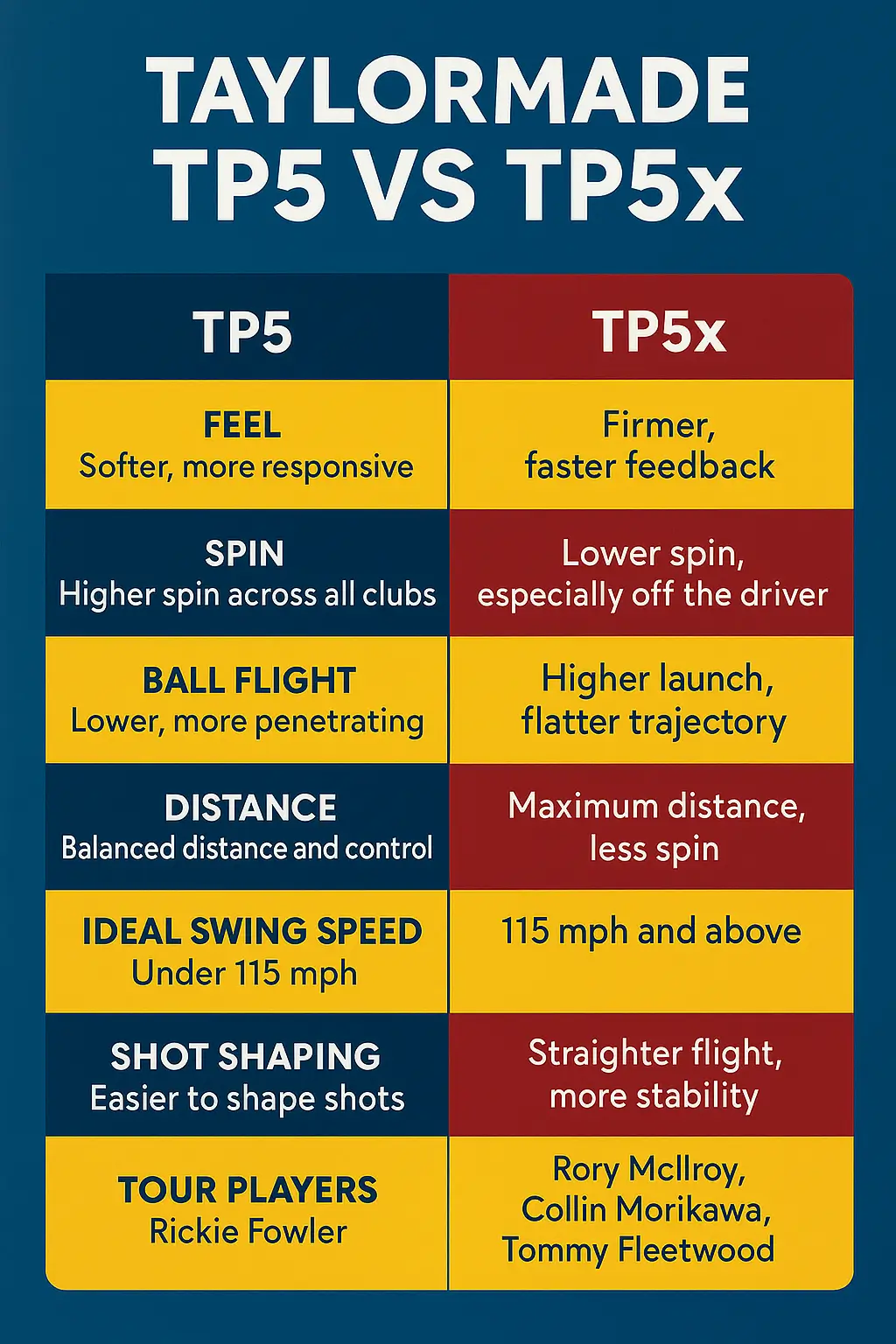
Choosing between the TP5 and TP5x depends on your swing characteristics and performance priorities. The TP5 suits players who prioritize feel and short game control. The TP5x fits golfers seeking maximum ball speed and distance with reduced driver spin.
Swing speed plays a role in maximizing each ball’s potential. Players with swing speeds below 100 mph may not unlock the full distance advantage of the TP5x off the tee. The carry distance gains appear most prominently at swing speeds of 115 mph and above.
- TP5 fits these players: Those preferring softer feel, more wedge spin, lower ball flight, better shot shaping ability
- TP5x fits these players: Those seeking firm feel, maximum distance, higher launch, less driver spin
- Swing speed consideration: TP5x shows distance advantages at 115 mph and above
- Ball flight preference: TP5 produces more penetrating trajectory, TP5x launches higher
- Spin profile: TP5 generates more spin throughout the bag
- Tour validation: Rory McIlroy, Collin Morikawa, Tommy Fleetwood play TP5x; Rickie Fowler plays TP5
The TP5 works better for golfers with naturally high ball flights or those playing in windy conditions. The more penetrating trajectory holds its line better in wind. Players who shape shots benefit from the added spin for working the ball left or right.
The TP5x appeals to golfers wanting the ball to roll out after landing. The higher launch with lower spin creates a flatter descent angle. This combination produces more roll, extending total distance. Players who struggle getting the ball airborne with long clubs benefit from the TP5x’s launch characteristics.
Professional validation supports both models. Rory McIlroy switched to the TP5x and immediately won the Hero Dubai Desert Classic. He reported gaining half a club of distance with his irons. Multiple tour professionals switched back to the TP5x after improvements to greenside spin in the latest generation.
Value Comparison and Alternative Options
Both balls retail at the same price point of $54.99 per dozen in the United States and £44.99 in the United Kingdom. This pricing positions them below competitors like the Titleist Pro V1 and Pro V1x while offering unique five-layer construction.
The identical pricing removes cost as a decision factor. Players can choose based purely on performance characteristics rather than budget considerations. Both models offer variants including Pix with ClearPath Alignment, Stripe patterns, and MySymbol customization at an additional cost.
- Standard pricing: $54.99 / £44.99 per dozen for both models
- Special editions: Pix, Stripe, and MySymbol variants available at premium pricing
- Hi-Vis yellow: Enriched urethane stays brighter longer than painted alternatives
- Durability: Soft cast urethane cover resists cuts and scuffs
- Alternative tour balls: Titleist Pro V1/V1x, Callaway Chrome Tour/Tour X, Wilson Staff Model/Model X
- Value proposition: Five-layer construction at competitive tour ball pricing
I compared these balls against 22 other models. The Wilson Staff Model X and Callaway Chrome Tour X produced longer carry distances if distance is the primary goal. The Titleist Pro V1x delivered more wedge spin for players prioritizing stopping power.
The TP5 and TP5x excel in specific areas. The TP5x ranked third for ball speed and produced the lowest driver spin of all premium tour balls tested. The TP5 ranked sixth for 7-iron spin while offering a softer feel than most competitors. Neither ball dominates every category, but both perform well across all shots.
The five-layer construction differentiates these balls from competitors using three or four layers. This design allows TaylorMade to optimize performance characteristics independently for different shot types. Players valuing this technology approach may prefer the TP5 or TP5x over simpler constructions.
Testing Methods and Real-World Performance
Robot testing provides objective data by eliminating human inconsistency. A controlled indoor environment removes weather variables that affect outdoor range testing. Testing at Loughborough University used a robot valued at over $100,000 to ensure precision.
The testing protocol involved hitting multiple shots at swing speeds of 100, 107, and 115 mph with driver. Seven-iron and pitching wedge testing followed at tour-level swing speeds. Each ball underwent evaluation for ball speed, spin rate, carry distance, peak height, descent angle, and shot dispersion.
- Testing equipment: Precision robot valued over $100,000
- Test environment: Indoor facility eliminating wind and weather variables
- Driver speeds tested: 100, 107, and 115 mph
- Metrics measured: Ball speed, spin rate, carry, peak height, descent angle, shot area
- Consistency advantage: Robot delivers identical swing every time
- Sample size: Multiple shots with each club to establish averages
Doing your own testing remains important for evaluating feel, sound, and visual appeal. No golfer can match the consistency required for accurate performance comparison across multiple models. The robot hits shots at identical speeds from the same location repeatedly without fatigue.
Neverthless, feedback from tour professionals validates the robot findings above. Rickie Fowler noted gaining distance from 220 yards to 227 yards with his 5-iron after switching to the new generation (The TP5x). Rory McIlroy reportedly gained 2 mph of ball speed with the 2024 models during testing on the TaylorMade tour truck.
Club players should test both balls themselves to determine personal preference. A fitting session helps identify which model performs better with your swing. TaylorMade runs challenges throughout the season allowing golfers to test the balls against their current model. The company claims players gain five yards of carry distance in just five shots during these challenges.
Frequently Asked Questions
What is the main difference between TP5 and TP5x golf balls?
The TP5 produces more spin throughout the bag with a softer feel, while the TP5x generates higher ball speeds with less driver spin and a firmer feel. The TP5 has 88 compression compared to 93 for the TP5x. Both use five-layer construction, but the TP5 prioritizes greenside control and the TP5x emphasizes distance and ball speed.
Which ball flies higher, the TP5 or TP5x?
The TP5x launches higher than the TP5 but produces a flatter overall trajectory. The TP5 creates a more penetrating ball flight that holds better in wind. Peak heights with 7-iron differed by only 0.2 yards between the models, but the TP5x’s higher launch becomes more noticeable with driver.
Does the TP5x really go further than the TP5?
The TP5x produces longer carry distances primarily at swing speeds of 115 mph and above, gaining nearly 2 yards over the TP5 in robot testing. At 100 mph swing speeds, carry distances were nearly identical. With a 7-iron, the TP5x averaged 1.3 yards longer. Players with average swing speeds may not see significant distance gains from the TP5x.
Which ball has better spin around the greens?
The TP5 generates more spin around the greens, though the difference is smaller than many expect. With a pitching wedge, spin rates differed by only 11 rpm between the models. With a 7-iron, the TP5 produced 204 rpm more backspin. The TP5 ranked sixth highest for 7-iron spin among 24 balls tested, while both models performed similarly with wedges.
Should I switch from Pro V1x to TP5 or TP5x?
The TP5x most closely matches the Pro V1x in terms of firmness and performance characteristics. The TP5x produces lower driver spin and similar ball speeds compared to the Pro V1x. If you prioritize softer feel with more spin, the TP5 offers an alternative. Robot testing showed the TP5x gained 2.2 yards over the Pro V1 with a 7-iron, suggesting potential distance advantages with longer clubs.