
Construction and Design Differences
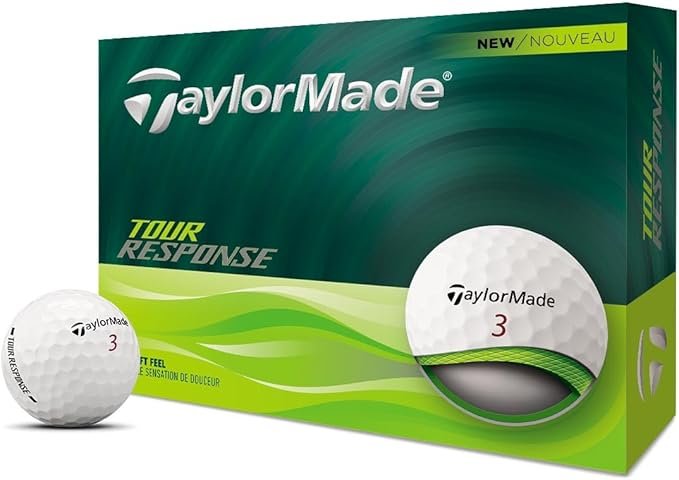
TaylorMade Tour Response
VIEW PRICE ON AMAZON
The core difference between these balls lies in their construction. The Tour Response features a three-piece design with a soft, tough urethane cover and measures approximately 73 compression. The TP5 uses a five-piece construction with a cast urethane cover and registers around 87 compression. Both balls feature 322 dimples, but the TP5 includes TaylorMade’s seamless Tour Flight Dimple pattern, which is larger and wider to improve aerodynamics and extend carry distance.
- Tour Response: Three-piece construction with lower compression for easier compression at moderate swing speeds
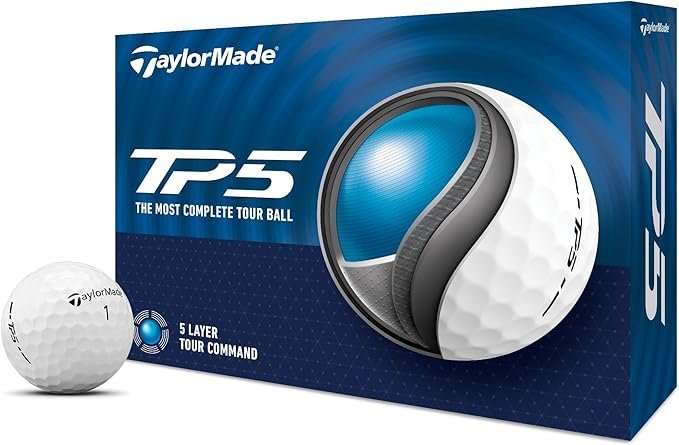
- TP5: Five-piece construction with Speed Layer system for increased ball speed and spring-like effect
- Cover material: Both use urethane covers, though the TP5’s cast urethane is slightly more durable
- Dimple design: Tour Response has standard dimples while TP5 features advanced Tour Flight Dimple technology
The TP5’s five-layer construction includes a larger, more reactive core surrounded by progressively stiffer layers. This design creates more ball speed and better energy transfer. The Tour Response uses a high-spring core paired with a thinner speed mantle layer for good ball speed at a lower price point.
(image representing [cross-section comparison of three-piece vs five-piece golf ball construction])
Driver Performance and Distance
VIEW PRICE ON AMAZON
Launch monitor testing reveals distinct performance differences off the tee. The Tour Response produces lower spin rates, typically around 700 rpm less than the TP5. This lower spin creates more roll, which can add yards to total distance despite slightly shorter carry distances. The TP5 launched approximately four yards longer on carry but the Tour Response gained back six yards in total distance due to increased roll.
- Spin rates: Tour Response spins significantly less off the driver, creating a flatter trajectory
- Peak height: TP5 flies approximately five yards higher than the Tour Response
- Total distance: Tour Response can be longer overall due to reduced spin and more roll
- Ball flight: TP5 launches higher and holds its line better in wind conditions
- Carry distance: TP5 carries a few yards farther with optimized aerodynamics
The choice depends on your launch characteristics. If you already launch the ball high with excessive spin, the Tour Response will help control trajectory. Players with low launch and low spin will benefit more from the TP5’s higher flight and increased carry distance. The TP5 performed better in windy conditions, holding its line with what testers described as a rope-like flight pattern.
Iron Performance and Ball Flight
Testing with seven-irons showed the Tour Response producing spin rates around 7,500 rpm while the TP5 averaged approximately 6,850 rpm of backspin. This aligns with TaylorMade’s Tour Flight Dimple technology goals of launching higher, spinning less, and carrying farther. Ball speed remained consistent between 117 and 120 mph for the Tour Response, with shot groupings between 170 and 176 yards.
- Launch angle: Both balls launch well with good peak height for holding greens
- Descent angle: TP5 creates a steeper descent angle for better stopping power
- Short iron performance: TP5 launches lower with more spin using wedges
- Mid-iron consistency: Both provide stable flight with TP5 offering better peak height
- Distance consistency: TP5 produced more consistent carry distances on well-struck shots
The TP5 consistently produced five to ten extra yards on well-struck iron shots. With shorter irons, the TP5 launched lower and spun more, creating an ideal combination for attacking pins. The Tour Response performed well with a low to mid launch on pitch shots and showed good hop-and-stop characteristics, though not quite matching the TP5’s performance.
Wedge Spin and Greenside Control
The most significant performance gap appears in greenside spin. Full wedge shots with the TP5 generated approximately 1,000 rpm more spin than the Tour Response. The descent angle remained similar between both balls, but the increased spin on the TP5 translates to substantially better stopping power on approach shots.
- Full wedge spin: TP5 generates roughly 1,000 rpm more backspin than Tour Response
- Stopping power: TP5 stops on contact while Tour Response rolls out several feet
- Partial wedge control: TP5 offers more precise distance control inside 50 yards
- Chip shot spin: Both balls provide good spin, but TP5 gives sharper response
- Pitch shot performance: Tour Response spins adequately but lacks the precision of TP5
Around the greens, the TP5 provides the feeling of complete control. Where you place the ball is where it stays. The Tour Response offers a clear improvement over two-piece distance balls and performs well for most situations, but it doesn’t match the TP5’s ability to stop quickly. For players who prioritize greenside performance, this difference alone may justify the extra cost.
Feel and Putting Performance
The Tour Response feels noticeably softer than the TP5, measuring lower on the compression scale. Both balls qualify as having a soft feel, though the TP5 feels slightly firmer and more responsive. The TP5 produces a hotter sensation off the clubface, particularly with the driver, though the difference is minimal in practice.
- Compression feel: Tour Response is softer with its 73 compression rating
- Impact sensation: TP5 feels firmer but more explosive, especially on long shots
- Off-center hits: Tour Response can feel dull on mishits while TP5 maintains better feedback
- Putting feel: TP5 has a slightly firmer feel that some players prefer for distance control
- Overall responsiveness: Both provide good feedback without being too soft or too firm
On the putting green, the TP5 has a marginally firmer feel compared to the Tour Response. Neither ball feels so soft that you lose your intended line. The Tour Response won’t disappoint, but the TP5’s feel leaves a stronger impression. Both balls roll well on the greens and hold the surface nicely without excessive skidding or bouncing.
Durability and Value
Both balls feature urethane covers that hold up well over multiple rounds. The cast urethane construction on both models provides good durability without excessive scuffing or cover damage. The seamless tour flight dimple pattern on both balls maintains consistent performance even after several rounds of play.
- Cover durability: Both balls withstand normal wear through multiple rounds
- Scuff resistance: Cast urethane on both models resists wedge marks reasonably well
- Price difference: Tour Response costs approximately $10 less per dozen than TP5
- Value proposition: Tour Response offers good performance at lower cost for moderate swing speeds
- Performance per dollar: TP5 justifies higher cost with superior greenside control and consistency
The TP5 is priced appropriately for a premium five-piece tour ball. The Tour Response sits at a fair price point given its urethane cover and three-piece construction. For players who prioritize greenside spin and control, the extra $10 per dozen for the TP5 represents good value. However, the Tour Response is not just a budget option—it’s a quality ball that performs well for players with moderate to fast swing speeds who don’t require maximum greenside spin.
Which Ball Suits Your Game
The choice between these balls depends on your swing speed, launch characteristics, and what you value most in performance.
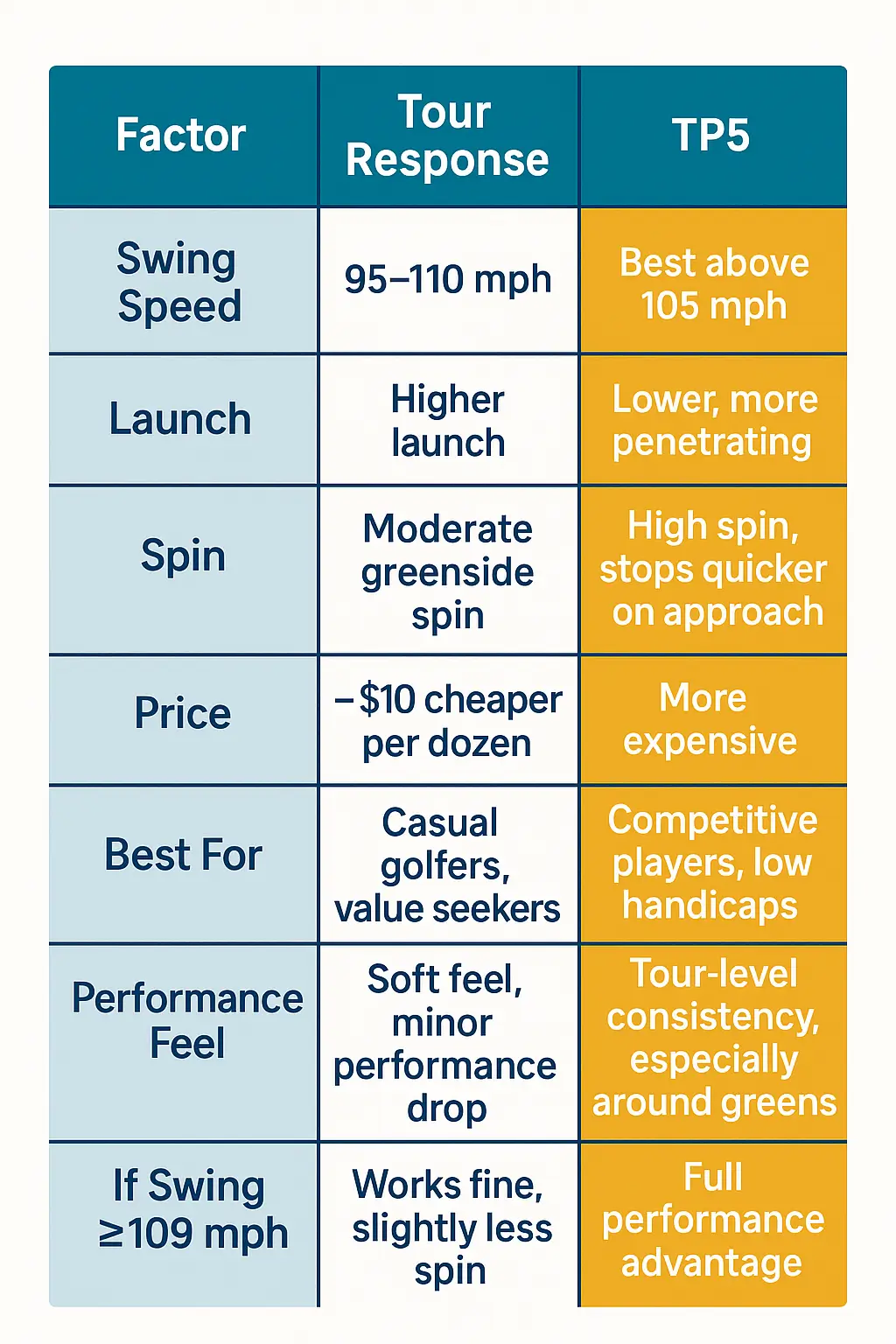
The Tour Response works well for players with average to moderately fast swing speeds who want a softer feel and more total distance through reduced spin. The TP5 is designed for players with faster swing speeds who demand maximum greenside control and don’t mind paying extra for it.
- Swing speed consideration: Tour Response suits 95-110 mph while TP5 performs best above 105 mph
- Launch profile: Choose Tour Response for high launch, TP5 for penetrating trajectory
- Spin needs: TP5 essential for players who rely on spin to stop approach shots quickly
- Budget factor: Tour Response saves $10 per dozen with minor performance trade-offs
- Playing style: Competitive players benefit more from TP5’s consistent performance
Players who swing the driver at 109 mph or faster can play either ball successfully. The Tour Response will provide adequate performance with slightly less spin around the greens. The TP5 delivers tour-level performance across all shot types, particularly excelling in greenside situations. If you regularly compete and need every advantage, the TP5 is worth the investment. For casual play or if you frequently lose balls, the Tour Response offers excellent value.
(image representing [comparison chart showing ideal player profiles for each ball])
Frequently Asked Questions
Does the TaylorMade Tour Response replace the TP5 for most golfers?
No, the Tour Response does not replace the TP5. These balls serve different purposes. The Tour Response is designed as an affordable option for players with moderate swing speeds who want urethane cover performance without premium pricing. The TP5 remains TaylorMade’s premium tour ball with superior greenside spin and performance optimized for faster swing speeds. While the Tour Response may provide more total distance through reduced spin, it cannot match the TP5’s control around the greens.
Can high handicappers benefit from playing the Tour Response?
Yes, high handicappers with moderate to fast swing speeds can benefit from the Tour Response. The ball provides better feel and responsiveness than cheap two-piece balls while offering improved greenside performance. However, high handicappers who struggle with low launch or insufficient distance might find better results with the TaylorMade Soft Response or Distance Plus balls, which are designed to help generate more height and carry.
What is the actual spin difference between these balls with wedges?
Launch monitor testing shows the TP5 generates approximately 1,000 rpm more spin on full wedge shots compared to the Tour Response. This significant difference translates to noticeably better stopping power with the TP5. On partial wedge shots and chips inside 50 yards, the gap remains consistent, with the TP5 providing sharper response and more precise control. The Tour Response still spins adequately and performs better than two-piece balls, but it clearly sits below tour-level performance in this area.
How do wind conditions affect each ball differently?
The TP5 performs substantially better in windy conditions. Its Tour Flight Dimple pattern and five-piece construction create a more penetrating ball flight that holds its line well. Testers described the TP5’s flight as rope-like in crosswinds. The Tour Response launches higher and spins more with the driver, making it more susceptible to wind influence. This difference becomes most apparent on exposed courses or during windy rounds where shot control is critical.
Is the durability comparable between these two balls?
Both balls offer similar durability thanks to their urethane covers and seamless dimple patterns. Testing over multiple rounds showed both balls maintaining their performance characteristics without excessive scuffing or cover damage. The cast urethane construction on both models provides good resistance to wedge marks and normal wear. Neither ball shows a clear durability advantage, so your choice should focus on performance characteristics rather than longevity concerns.