

The Callaway Warbird and Supersoft represent two distinct approaches to golf ball design. Both balls aim to help golfers improve their game, but they do so in different ways. The Warbird focuses on distance with a firmer construction, while the Supersoft emphasizes feel with an ultra-low compression core.
Construction Differences Between Warbird and Supersoft
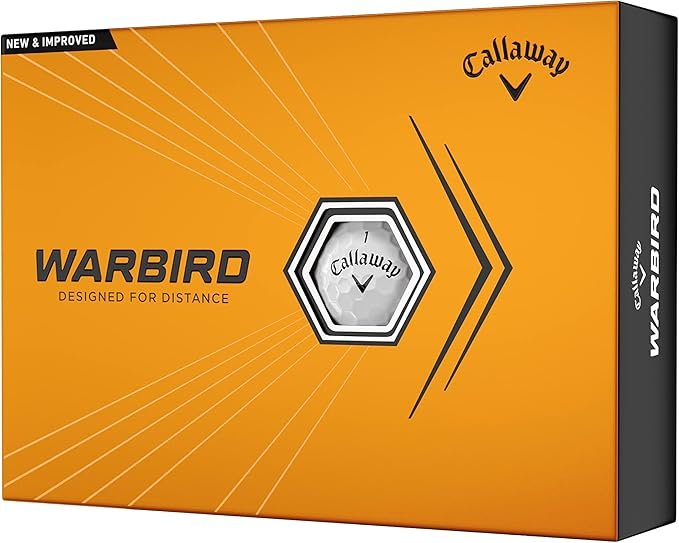
Callaway Warbird
Both golf balls feature 2-piece construction, but their internal design differs significantly. Understanding these differences helps explain their performance characteristics on the course.
Key Construction Features
- Compression rating: The Warbird has a 90 compression rating while the Supersoft measures just 40 compression
- Core design: The Warbird uses a large, high-energy core designed for distance, whereas the Supersoft features a HyperElastic SoftFast core
- Cover material: The Warbird uses a hybrid cover, while the Supersoft also employs a hybrid cover with Hex aerodynamics
- Dimple pattern: Both balls feature 332 dimples, though the aerodynamic design differs between models
The compression difference represents the most significant distinction between these balls. At 90 compression, the Warbird sits in the mid-to-firm range, while the Supersoft’s 40 compression makes it one of the softest balls available. This compression gap directly affects how each ball responds to impact at different swing speeds.
Performance Comparison: Robot Test Data
Robot testing provides objective performance data across multiple swing speeds. The results reveal how each ball performs for different player profiles.
Driver Performance at Multiple Swing Speeds
- At 114 mph swing speed, the Warbird produced 163.0 mph ball speed and carried 270.9 yards. The Supersoft generated 160.0 mph ball speed with 266.6 yards of carry. Both balls launched at similar angles, but the Warbird produced 2,683 rpm backspin compared to the Supersoft’s 2,424 rpm.
- At 93 mph swing speed, the Warbird achieved 133.7 mph ball speed and 209.2 yards carry distance. The Supersoft measured 132.3 mph ball speed with 206.5 yards carry. The Warbird generated 2,611 rpm while the Supersoft produced 2,334 rpm backspin.
- At 78 mph swing speed, performance differences narrowed. The Warbird reached 113.0 mph ball speed with 161.3 yards carry, while the Supersoft achieved 112.5 mph ball speed and 160.8 yards carry distance.
Iron Play Characteristics
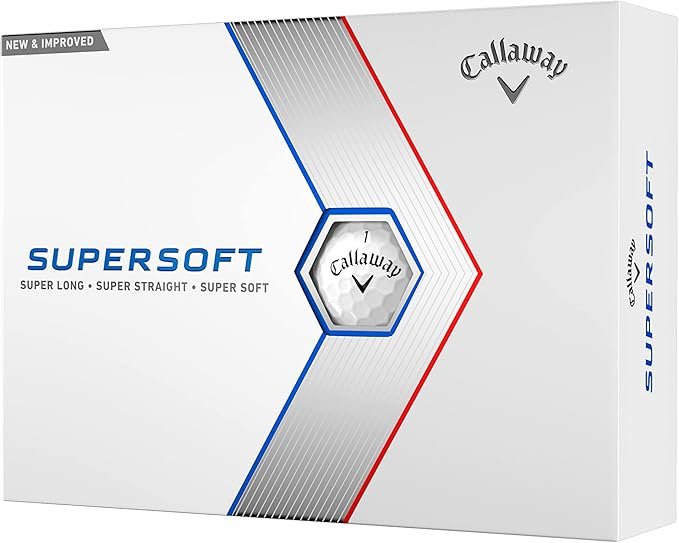
Callaway Supersoft
With 7-iron testing, the Warbird delivered 157.9 yards carry with 4,273 rpm backspin. The Supersoft traveled 159.7 yards with 3,881 rpm backspin. Both balls produced similar ball speeds around 108 mph, but the Supersoft launched higher at 22.1 degrees compared to the Warbird’s 21.6 degrees.
Short Game Performance Analysis
Short game performance often determines scoring ability. The robot test evaluated both balls on a 40-yard pitch shot to measure greenside spin and control.
Greenside Spin Comparison
- Warbird spin rate: 5,963 rpm on partial wedge shots
- Supersoft spin rate: 5,500 rpm on partial wedge shots
- Carry distance: Warbird carried 40.3 yards, Supersoft carried 42.4 yards
- Peak height: Warbird reached 6.9 yards, Supersoft reached 7.8 yards
The Warbird generated more backspin around the greens, producing 463 more revolutions than the Supersoft. This additional spin can help better players control their wedge shots and stop the ball quicker on approach shots. However, both balls are 2-piece models, so neither offers premium-level greenside control like 3-piece or 4-piece tour balls.
The Warbird ranked as the second-highest spinning 2-piece golf ball in the short game performance category during robot testing. The Supersoft ranked lower overall for short game spin but still provides adequate performance for golfers who cannot generate significant spin through technique alone.
Feel and Sound Characteristics
The subjective experience of hitting each ball differs noticeably. These differences stem from compression ratings and cover materials.
On-Course Feel Assessment
The Warbird produces a firmer feel at impact. Some testers described the sensation as slightly clicky or clunky, particularly on short game shots. This firmer response provides feedback but may not appeal to golfers who prefer a soft sensation.
The Supersoft delivers an extremely soft feel, true to its name. The ultra-low compression creates a sensation that some testers found too squishy, particularly on full shots. Others appreciated the cushioned impact, especially on mishits. The soft feel extends to putting, where the ball provides less feedback than firmer models.
Players with moderate to fast swing speeds often find the Supersoft feels overly soft. The ball can feel like it stays on the clubface too long, reducing the sense of control. Conversely, the Warbird’s firmer construction provides a more solid sensation that faster swingers typically prefer.
Distance Capabilities: Which Ball Goes Farther?
Distance remains a primary consideration for most golfers. The robot testing data reveals clear patterns about how each ball performs in this category.
Carry Distance Results
- Fast swing speeds (114 mph): Warbird carried 4.3 yards farther
- Medium swing speeds (93 mph): Warbird carried 2.7 yards farther
- Slow swing speeds (78 mph): Warbird carried 0.5 yards farther
The Warbird consistently produced longer carry distances across all three driver swing speeds tested. The advantage proved most significant at faster swing speeds, where the firmer construction translated into higher ball speeds and more efficient energy transfer.
Total distance tells a more complete story than carry distance alone. The Warbird’s lower spin rates mean the ball rolls out farther after landing. The Supersoft’s higher launch and lower spin also promote roll, but the Warbird typically gains more yards on the ground.
The Warbird ranked third among 2-piece balls for tee-to-green performance and earned silver medals at both 93 mph and 78 mph swing speeds. The Supersoft performed respectably but did not earn similar accolades in distance categories.
Spin Characteristics Throughout the Bag
Spin rates affect both distance control and shot shape. Understanding how each ball spins with different clubs helps predict on-course performance.
Long Game Spin Comparison
The Supersoft produced the lowest spin rates of any Callaway ball tested. At 114 mph driver speed, it generated 2,424 rpm compared to the Warbird’s 2,683 rpm. This pattern continued at 93 mph (2,334 rpm vs 2,611 rpm) and 78 mph (2,060 rpm vs 2,346 rpm).
Lower driver spin typically benefits golfers who hit slices, as reduced sidespin helps keep the ball straighter. The Supersoft ranked as the second-lowest spinning golf ball at 114 mph and the lowest-spinning at 93 mph and 78 mph among all 2-piece balls tested.
Mid-Iron Spin Patterns
With 7-iron shots, the Warbird produced 4,273 rpm while the Supersoft generated 3,881 rpm. This 392 rpm difference affects how the ball behaves on approach shots. The Warbird descended at 44.9 degrees compared to the Supersoft’s 44.4 degrees, indicating slightly more stopping power.
(image representing [spin comparison chart across different clubs])
Neither ball produces tour-level spin on iron shots. Both are designed primarily for distance rather than aggressive spin control. Golfers who need to work the ball significantly or attack firm greens may find both options limiting compared to multi-layer tour balls.
Durability and Value Assessment
Price and longevity factor into the overall value proposition. Both balls target the budget-conscious segment but differ in durability characteristics.
Durability Observations
The Warbird’s firmer construction generally shows better resistance to scuffs and cuts. The cover maintains its appearance through multiple rounds of play. Testers found the ball could withstand repeated wedge shots without excessive wear.
The Supersoft’s extremely soft cover marks more easily. Wedge shots and cart path encounters leave visible scuffs. However, the ball maintains its performance characteristics despite cosmetic damage. Some players appreciate that visible wear helps them identify their ball and know when to retire it.
Price Comparison
- Warbird pricing: Approximately $18-20 per dozen
- Supersoft pricing: Approximately $25-27 per dozen
- Cost per ball: Warbird costs roughly $1.50-1.67, Supersoft costs $2.08-2.25
The Warbird represents Callaway’s most affordable option, making it an excellent choice for golfers who lose balls frequently or want to stock up without significant investment. The Supersoft costs more but remains reasonably priced compared to premium balls that exceed $40 per dozen.
Ideal Player Profiles for Each Ball
Matching the right ball to your game produces the best results. Consider these player profiles when choosing between the Warbird and Supersoft.
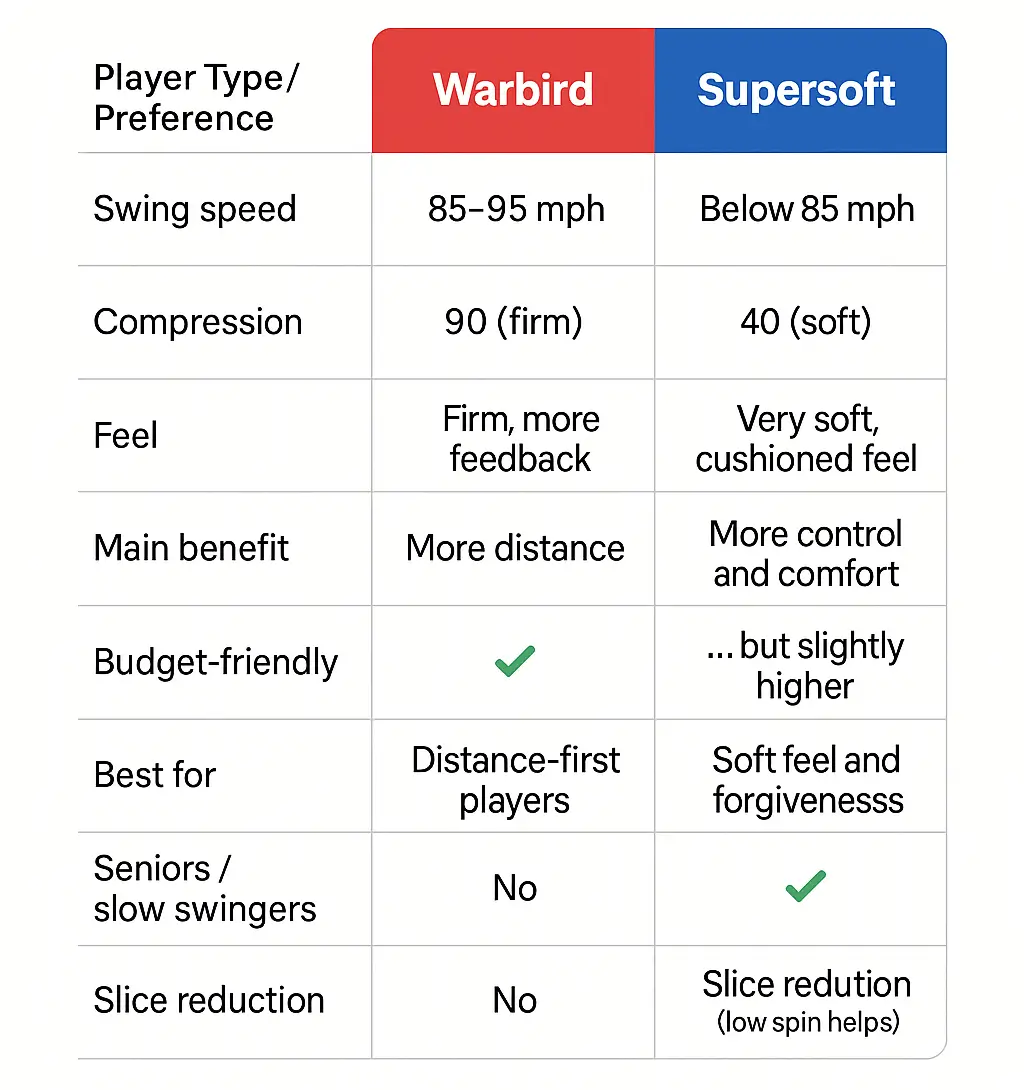
Golfers Who Should Choose the Warbird
- Players with moderate swing speeds: The 90 compression works well for speeds between 85-95 mph
- Distance-focused golfers: Those who prioritize length over feel will appreciate the Warbird’s performance
- Budget-conscious players: The lower price point makes stocking up easy
- Golfers who prefer firm feel: Players who like feedback at impact will enjoy the Warbird’s response
Golfers Who Should Choose the Supersoft
- Slow swing speed players: The 40 compression suits speeds below 85 mph
- Senior golfers: Mature players often appreciate the soft feel and easy compression
- Slice-prone golfers: The ultra-low spin helps reduce sidespin and keep shots straighter
- Players seeking soft feel: Golfers who prioritize comfort over feedback will prefer the Supersoft
High handicappers can succeed with either ball. The Warbird offers better tee-to-green performance and costs less, making it suitable for players still developing their game. The Supersoft provides more forgiveness and a softer feel that beginners often find appealing.
Weather and Course Condition Considerations
Environmental factors affect ball performance. Each model responds differently to various playing conditions.
Cold Weather Performance
All golf balls lose distance in cold temperatures, but low-compression balls typically perform better when the mercury drops. The Supersoft’s 40 compression means it compresses more easily even when cold, helping maintain performance. The Warbird’s higher compression feels even firmer in cold conditions, potentially reducing distance gains.
Wet Conditions and Soft Greens
The Warbird’s additional spin can help control shots into soft greens. When conditions are wet, the extra 400-500 rpm on wedge shots makes a noticeable difference in stopping power. The Supersoft provides less bite but may roll more predictably on saturated surfaces.
Wind Performance
Lower spin rates generally help in windy conditions. The Supersoft’s reduced spin keeps the ball flight more penetrating, helping maintain distance and direction when the wind blows. The Warbird spins more, making it slightly more susceptible to wind effects, though the difference is modest compared to high-spin tour balls.
Alternative Callaway Options to Consider
Callaway offers other balls that might suit your needs better than either the Warbird or Supersoft. These alternatives fill different niches in the lineup.
Callaway ERC Soft
The ERC Soft sits between the Supersoft and premium Chrome Soft in terms of construction and price. This 3-piece ball features 87 compression and provides more greenside spin than either 2-piece option. Robot testing showed the ERC Soft generated 5,592 rpm on pitch shots, roughly 500-600 rpm less than the Warbird but with better overall feel and performance.
Callaway Chrome Soft
The Chrome Soft represents a significant step up in technology and cost. This 3-piece ball with 81 compression offers tour-level feel with more spin control than either 2-piece option. Players who graduate from the Warbird or Supersoft often move to the Chrome Soft when their game improves and they need more performance around the greens.
Frequently Asked Questions
What is the main difference between Callaway Warbird and Supersoft golf balls?
The compression rating represents the primary difference. The Warbird has 90 compression for a firmer feel and more distance, while the Supersoft has 40 compression for an extremely soft feel. The Warbird produces more spin throughout the bag, whereas the Supersoft generates less spin to help reduce hooks and slices. Both are 2-piece distance balls, but they serve different player preferences.
Which ball flies farther, the Warbird or Supersoft?
The Warbird travels farther across all swing speeds tested. At 93 mph driver speed, the Warbird carried 209.2 yards compared to the Supersoft’s 206.5 yards. The difference increases at faster swing speeds and decreases at slower speeds. The Warbird also achieves more total distance due to lower spin promoting additional roll after landing.
Should beginners choose Warbird or Supersoft golf balls?
Both balls work for beginners, but most new golfers prefer the Supersoft initially due to its forgiving nature and soft feel on mishits. However, the Warbird offers better overall performance and costs less, making it a smart choice for beginners who lose balls frequently. Players should consider their swing speed—slower swingers benefit more from the Supersoft’s low compression, while those with moderate speeds get more from the Warbird.
Do Warbird golf balls spin more than Supersoft on wedge shots?
Yes, the Warbird produces approximately 463 more rpm on 40-yard pitch shots compared to the Supersoft. The Warbird generated 5,963 rpm while the Supersoft produced 5,500 rpm in robot testing. This additional spin helps the Warbird stop quicker on approach shots, though neither ball offers tour-level control. The Warbird ranked as the second-highest spinning 2-piece ball for short game performance.
How does compression affect which Callaway ball I should play?
Compression determines how much the ball deforms at impact and directly relates to swing speed requirements. The Supersoft’s 40 compression suits swing speeds below 85 mph, allowing slower swingers to fully compress the ball for maximum distance. The Warbird’s 90 compression works better for speeds between 85-100 mph. Playing a ball with compression matched to your swing speed maximizes distance and feel. Golfers with faster swing speeds find low-compression balls feel too soft and lose control, while slower swingers cannot properly compress firmer balls.
Conclusion: Making Your Decision
The Callaway Warbird and Supersoft serve distinct purposes despite both being 2-piece distance balls. The Warbird delivers better overall performance with more distance, more spin, and firmer feel at a lower price. The Supersoft provides extreme softness, reduced spin for straighter shots, and easier compression for slower swing speeds.
Most golfers with moderate swing speeds will benefit more from the Warbird’s performance advantages and value pricing. The ball produces noticeably more distance and spin while costing less per dozen. However, players with swing speeds below 85 mph should seriously consider the Supersoft, as its low compression allows them to maximize the ball’s potential.
Neither ball replaces premium multi-layer options for better players who need advanced spin control and tour-level performance. Both the Warbird and Supersoft excel as affordable distance balls that help mid-to-high handicappers improve their games without breaking the bank. Try both if possible: hitting each ball yourself reveals which construction and feel best matches your preferences and playing style.